abilene

From the August 2026 Table -
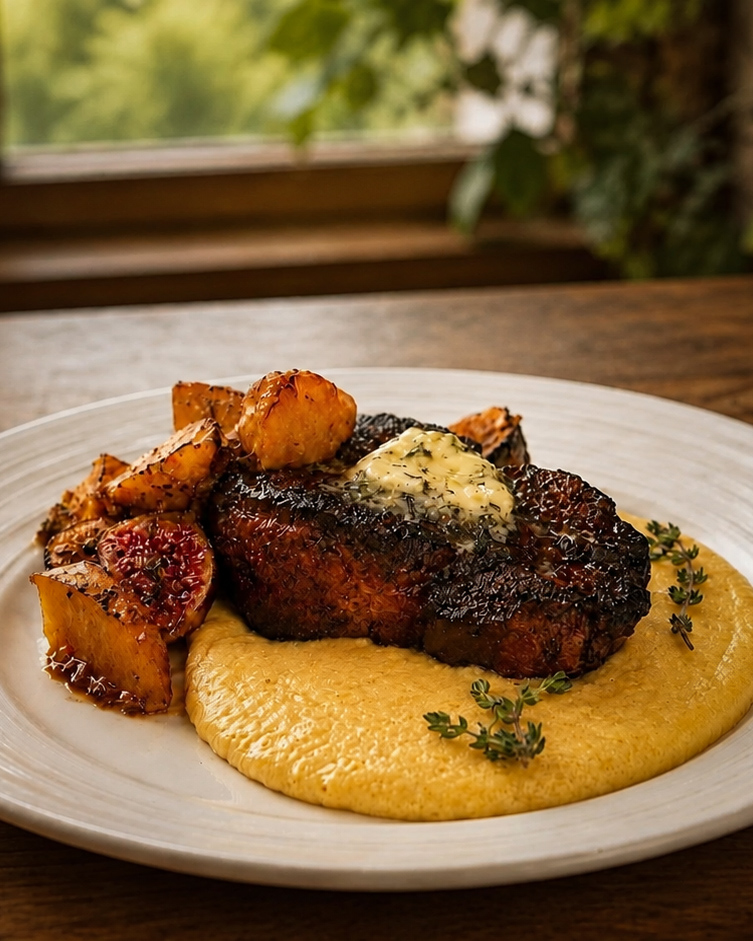
Thick-cut pork shoulder steaks cooked slowly over live fire, crowned with Dijon-cider butter, and served over creamy white cheddar polenta with a warm peach-and-fig gastrique. Inspired by West Texas and the summers I spent near Abilene, this plate brings smoke, fruit, fire, and comfort together.

Serves

4

time

~ 4.5 hrs

skill

7/10

Jump to recipe

ingredients

Pork Steaks

  • 2 boneless pork shoulder steaks, cut 2–2½ inches thick
  • Morton kosher salt, for dry-brining
  • Neutral oil, for binding the seasoning
  • Butcher’s twine, if needed
  • Flaky salt, for finishing

Pork Seasoning

  • 2 teaspoons smoked paprika
  • 1 teaspoon ground coriander
  • 1 teaspoon garlic powder
  • 1 teaspoon onion powder
  • ½ teaspoon coarsely ground black pepper
  • ½ teaspoon dried thyme
  • ¼ teaspoon ground clove
  • Small pinch of kosher salt, optional

Dijon-Cider Butter

  • ½ cup unsalted butter, softened
  • 2 teaspoons Dijon mustard
  • 1 teaspoon white wine vinegar
  • 1 small garlic clove, very finely grated
  • 1 teaspoon fresh thyme leaves, finely chopped
  • ½ teaspoon freshly ground black pepper
  • ¼ teaspoon Morton kosher salt

White Cheddar Polenta

  • 1 cup yellow corn polenta
  • 3½ cups chicken stock
  • ¾ teaspoon kosher salt
  • 2 tablespoons unsalted butter
  • 1 cup freshly shredded sharp cheddar
  • Whole milk or heavy cream, as needed
  • Freshly ground black pepper, to taste

Peach-and-Fig Gastrique

  • 2 ripe yellow peaches, skins left on and cut into wedges
  • 4–5 fresh figs, skins left on and quartered
  • 1 small shallot, finely minced
  • 1 tablespoon honey
  • 2½ tablespoons white wine vinegar
  • ⅓ cup low-sodium chicken stock
  • 1 teaspoon Calabrian chile
  • 1 teaspoon fresh thyme leaves
  • Approximately 1 teaspoon neutral oil, plus more for the peaches if needed
  • Kosher salt, to taste
  • Freshly ground black pepper, to taste

For Serving

  • Fresh thyme
  • Flaky finishing salt

directions

Prepare the Pork Steaks

  1. Cut two steaks from a boneless pork butt, each approximately 2–2½ inches thick. Tie the steaks around the outside with butcher’s twine if necessary to help hold their shape during the long cook.
  2. Season lightly with Morton kosher salt and refrigerate uncovered on a wire rack for several hours or overnight.
  3. Remove the steaks from the refrigerator approximately 30 minutes before cooking.

Make the Dijon-Cider Butter

  1. Combine the softened butter, Dijon mustard, white wine vinegar, grated garlic, fresh thyme, black pepper, and salt in a small bowl. Mix until completely incorporated.
  2. Transfer the butter to plastic wrap, shape it into a compact log, and twist the ends closed.
  3. Refrigerate until firm, then cut into thick coins for serving.

Season the Pork

  1. Combine the smoked paprika, coriander, garlic powder, onion powder, black pepper, dried thyme, and clove.
  2. Because the pork has already been dry-brined, use additional salt very lightly, if at all.
  3. Lightly coat the steaks with neutral oil and season evenly on every side.
  4. Allow the seasoning to adhere for 20–30 minutes before cooking.

Cook the Pork Steaks

  1. Prepare the Big Green Egg for direct cooking at approximately 275°F. Position the cooking grate on the highest rack available, creating as much distance as possible between the pork and the coals.
  2. Place the steaks on the raised grate and close the lid.
  3. Cook for approximately 4 hours, flipping and rotating the steaks after the first 30 minutes and approximately every 25–30 minutes afterward.
  4. Begin checking the internal temperature after about 2 hours.
  5. Start probing for tenderness once the steaks reach approximately 175°F.
  6. Continue cooking until a temperature probe passes easily through the major muscles and the internal fat has rendered. The steaks will generally finish between 185 and 195°F, depending on their thickness and composition.
  7. Transfer the pork to a clean tray and immediately top each steak with a thick coin of cider-Dijon thyme butter.
  8. Rest for 10–15 minutes while the butter melts into the crust.

Make the White Cheddar Polenta

  1. Add the polenta, water, and salt to the Instant Pot.
  2. Stir well, making sure no dry polenta remains stuck to the bottom.
  3. Secure the lid and cook on high pressure for 10 minutes.
  4. Allow the pressure to release naturally for 15 minutes before releasing any remaining pressure.
  5. Whisk the cooked polenta until smooth.
  6. Stir in the butter and cheddar, then add milk or cream a little at a time until the polenta is rich, creamy, and easily spoonable.
  7. Season with black pepper and additional salt only if needed.
  8. Keep warm until serving, thinning it again with milk or cream if it tightens as it sits.

Make the Peach-and-Fig Gastrique

  1. Heat a wide skillet over medium-high heat with a light coating of neutral oil.
  2. Add the peach wedges and cook for 2–3 minutes, turning as needed, until lightly charred while still holding their shape.
  3. Transfer the peaches to a plate.
  4. Reduce the heat to medium.
  5. Add approximately 1 teaspoon of neutral oil and the minced shallot. Cook for 2–3 minutes, until softened.
  6. Add the honey and allow it to bubble for approximately 30 seconds.
  7. Carefully add the white wine vinegar, followed by the chicken stock and Calabrian chile.
  8. Simmer for 4–7 minutes, until the liquid becomes glossy and lightly coats the back of a spoon.
  9. Taste the gastrique before adding the fruit. It should be tangy, lightly sweet, and gently spicy—not syrupy.
  10. Return the peaches to the skillet and toss gently for 60–90 seconds.
  11. Fold in the figs and cook for only 30–45 seconds, just long enough to warm them without allowing them to collapse.
  12. Remove the skillet from the heat.
  13. Fold in the fresh thyme and season with black pepper and a small pinch of salt.

Plate Abilene

  1. Spoon a generous pool of cheddar polenta slightly off-center on each plate.
  2. Place the pork partially over the polenta with its darkest crust facing forward.
  3. Spoon the warm peaches and figs alongside the pork, adding just enough gastrique to bring the fruit and polenta together without covering the pork’s crust.
  4. Finish with the melting cider-Dijon thyme butter, fresh thyme, and a few flakes of finishing salt.

Tennessee Tastebuds Tip

Keep the figs until the very end of the gastrique. Peaches can handle enough heat to develop color, but ripe figs need only a few seconds in the finished sauce. Adding them last preserves their shape and keeps the gastrique from becoming jammy.

Kitchen Notes

A boneless pork butt contains several different muscles, so the steaks may not become tender at exactly the same temperature. Use internal temperature to tell you when to begin checking, but let the feel of the probe determine when each steak is ready.